Optimise what you have
Before any purchase, find out what your current plan, habits and equipment can already deliver. Save answers three questions: where the room is, how much it is worth and on what basis, and what to do next.
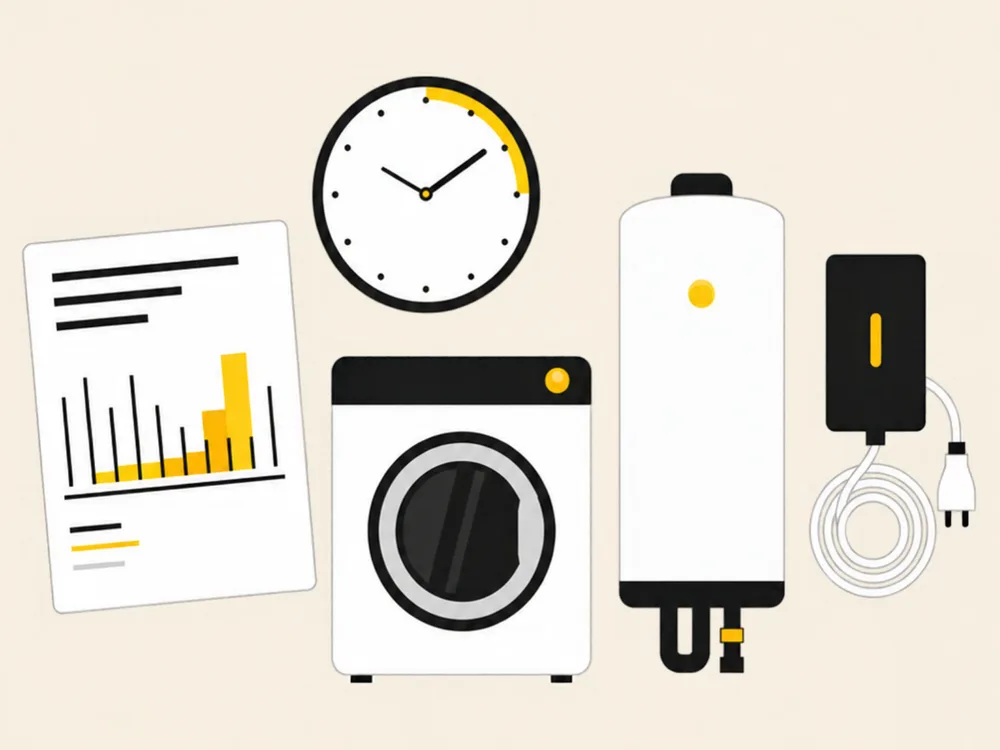
What we look at
- Bill diagnosis. We rebuild your bill from the rates you enter and check it against the bill total, so errors in the inputs show up early.
- Tariff structure. Single-rate, time-of-use and demand tariffs reward different habits. We price your usage under your plan and under an offer you want to compare.
- Time of use. We estimate how much usage sits in the peak window and how much of it can move.
- Scheduling. Hot water, EV charging, pool pumps, pre-cooling and appliances on delay timers.
- Existing solar. Using solar at home is usually worth far more than exporting it, so flexible loads move into solar hours first.
How savings are counted
Changes are applied in a fixed order: usage timing first, then demand, then plan. Each step is priced on the result of the one before, so the total equals the sum of its parts and nothing is counted twice.
Every saving has a central estimate, a range and a confidence level. Usage changes use a range of 60% to 120% of the central figure because real habits vary.
Limits we apply
- No more than 50% of the usage in any period is assumed to move.
- Shifted load can absorb at most 60% of exported solar, because sunshine and demand rarely line up perfectly.
- We do not estimate retail offers. Enter one you have found and we compare it on your usage.
What you get
Where the room is
A ranked list of changes, each tied to a specific load or plan feature.
What it is worth
Annual savings with ranges, the calculation behind each, and the assumptions used.
What to do next
Concrete actions in order of value, then whether to look at storage.